Why the Importance of Printing Family Photos Endures

August 10, 2026
The importance of printing photos usually hits when you can’t find the one image you swear you saved, but even more so when the memories begin to fade, and nothing is left on the walls to draw you back in again. I’ve met countless families in North East Georgia that ended up with thousands of photos saved to their phones and almost nothing on the wall or in reach.
What matters isn’t saving everything. It’s choosing the frames that hold a season before pregnancy, newborn business, and full family life blur into “later.”
A few things to catch early:
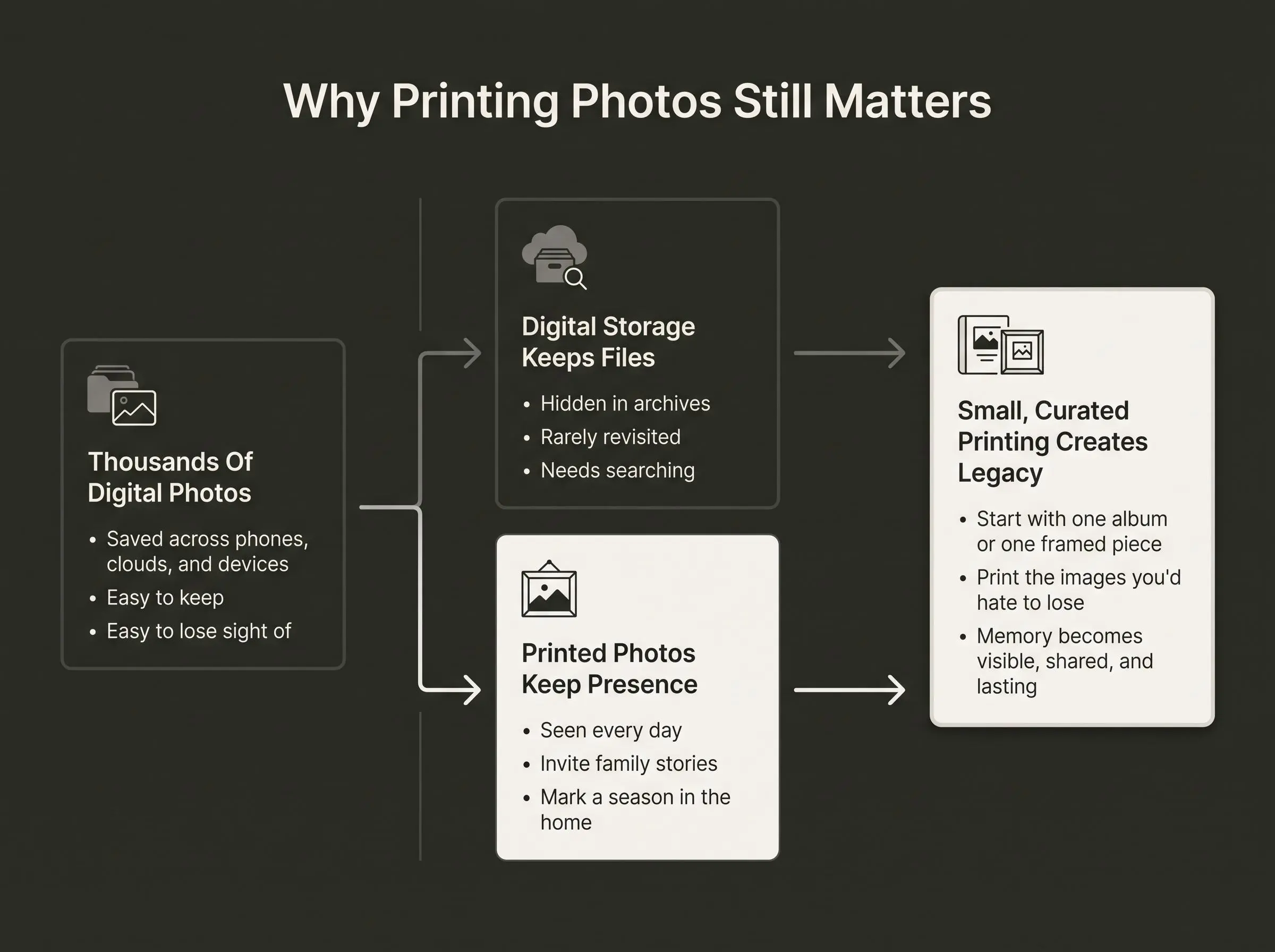
- digital storage keeps files, not presence
- the best images to print are usually the ones you’d hate to lose
- start with one album or one framed piece, and this gets real fast
Printing Photos Still Matters Because Memories Need to Be Seen, Not Just Stored
The importance of printing photos hasn’t faded just because cameras moved into our phones. If anything, it matters more now. We have more images than any generation before us, but we live with fewer of them.
That tension is the whole issue. Storage is not the same thing as remembrance.
Digital storage keeps files. Printed photographs keep presence. They stay in your line of sight, in your home, in the background of ordinary life where memory actually does its work. A family portrait in the hallway gets absorbed in small doses over years. A baby photo in a nursery becomes part of how that child understands they were welcomed here from the beginning. And a little psychology note here — research has shown that children who regularly see photos of themselves and their families displayed at home develop higher self-esteem, confidence, and a stronger sense of belonging.
Most families don’t regularly scroll back through the last five years of photos. They revisit images when a phone surfaces a memory notification or when they’re digging for one specific shot. That’s not the same as living with your photographs.
A print isn’t a rejection of technology. It’s a decision. In an age of excess, printing is curation.
The images you print become part of your family culture.
And that’s really the central point. Printing family photographs helps love, identity, and continuity move out of a hidden archive and into everyday life.
Why Digital Files Are Not Enough for the Memories You Most Want to Keep
Let’s say this plainly: why digital files are not enough comes down to both practical and emotional reality. They matter, but on their own, they ask too much of your future self.
Files get scattered fast:
- on your current phone
- on your last phone
- in text threads
- across laptops and external drives
- in cloud accounts you haven’t checked in months
We’ve all seen it. A family has thousands of images, but when they want that one newborn photo or the frame where everyone is actually in it, the search turns into a small excavation.
Then there’s the long game. Passwords get forgotten. Subscription plans change. Devices fail. File formats and platforms don’t stay still forever. Digital is useful, but when life is busy, it’s not as permanent as people assume.
The other problem is abundance. When everything gets saved, the images that matter most often disappear into the noise. A meaningful portrait competes with grocery screenshots, school emails, and twenty near-identical pictures taken two seconds apart. I have nearly 3,000 pictures favorited on my phone at this point, so clearly I’m not immune to our digital clutter!
Digital files are valuable as a starting point, but they are not usually a final destination.
A photo on a device has to be sought out. A printed photograph is simply there. You pass it on your way to fold laundry. Your child stops and asks who was holding them in that picture. Your guests notice it. And when you’ve taken the time to have your moments professionally captured, don’t they deserve more?
The delay trap is real. Families tell themselves they’ll make the album later, sort the photos later, print when things calm down. But life rarely calms down on command. The backlog grows. Meaning gets postponed.
Digital Photos Compared With Printed Photos, What Each Does Well and Where Each Falls Short
The conversation around digital photos vs printed photos gets unhelpful when people act like one has to replace the other. That isn’t how experienced families actually use photographs well.
Digital does a few things extremely well:
- it makes capture easy and immediate
- it allows backups and duplicates
- it makes sharing simple, especially across distance
- it gives you broad access to a huge archive
That’s all real value. I wouldn’t tell anyone to stop using digital tools. I rely on them too.
But digital also creates its own friction. Images on a screen are surrounded by distractions. Even a beautiful family portrait lives one swipe away from unread messages and app alerts. That changes how long you stay with an image. Most people don’t linger. They scroll.
Printed photographs ask for slower attention.
They also do things digital can’t quite replicate:
- they are tangible and immediately accessible
- they invite conversation without needing a device
- children can see them every day
- they can live as albums, framed pieces, canvases, matted prints; the list goes on
Printed photos do have tradeoffs. They require selection. They require some investment. They deserve decent materials and thoughtful placement. Cheap printing has its place, but it doesn’t solve every need. Because of this, I choose every client piece with intention and quality in mind.
Still, the strongest system is pretty clear. Capture digitally. Preserve intentionally. Print the images that define your family story.
What Happens if You Never Print Photos
If you’re wondering what happens if you never print photos, the answer isn’t dramatic all at once. It’s quieter than that, which is partly why it sneaks up on people.
Your favorite images become invisible.
Milestones start to blur because nothing in the home physically marks them. Pregnancy happened. The newborn stage happened. The years when your children still fit on your hip happened. You have proof. But proof and honor are not the same thing.
There is a relational cost too. Children grow up with fewer visible reminders of being seen and included in family history. Shared storytelling happens less often when memories stay trapped on private devices. An album on a coffee table gets opened by accident. A phone archive usually doesn’t.
A practical problem builds underneath all of this. The longer you wait, the harder selection becomes. Context fades first. Names, ages, dates, locations, and the reason a moment mattered start to loosen around the edges. By the third afternoon of trying to organize five years of photos, most people are tired before they get to the meaningful part.
Here’s the part families don’t think about enough:
- The first generation knows the story behind the image.
- The next generation remembers some of it.
- The third or fourth may inherit a file with almost no context at all.
An unlabeled file is not a legacy. It’s a mystery.
One phone or one account should never be the only home for important memories. Printing reduces future loss, not just present clutter.
Family Memories in Print Change How a Home Feels and How a Family Remembers
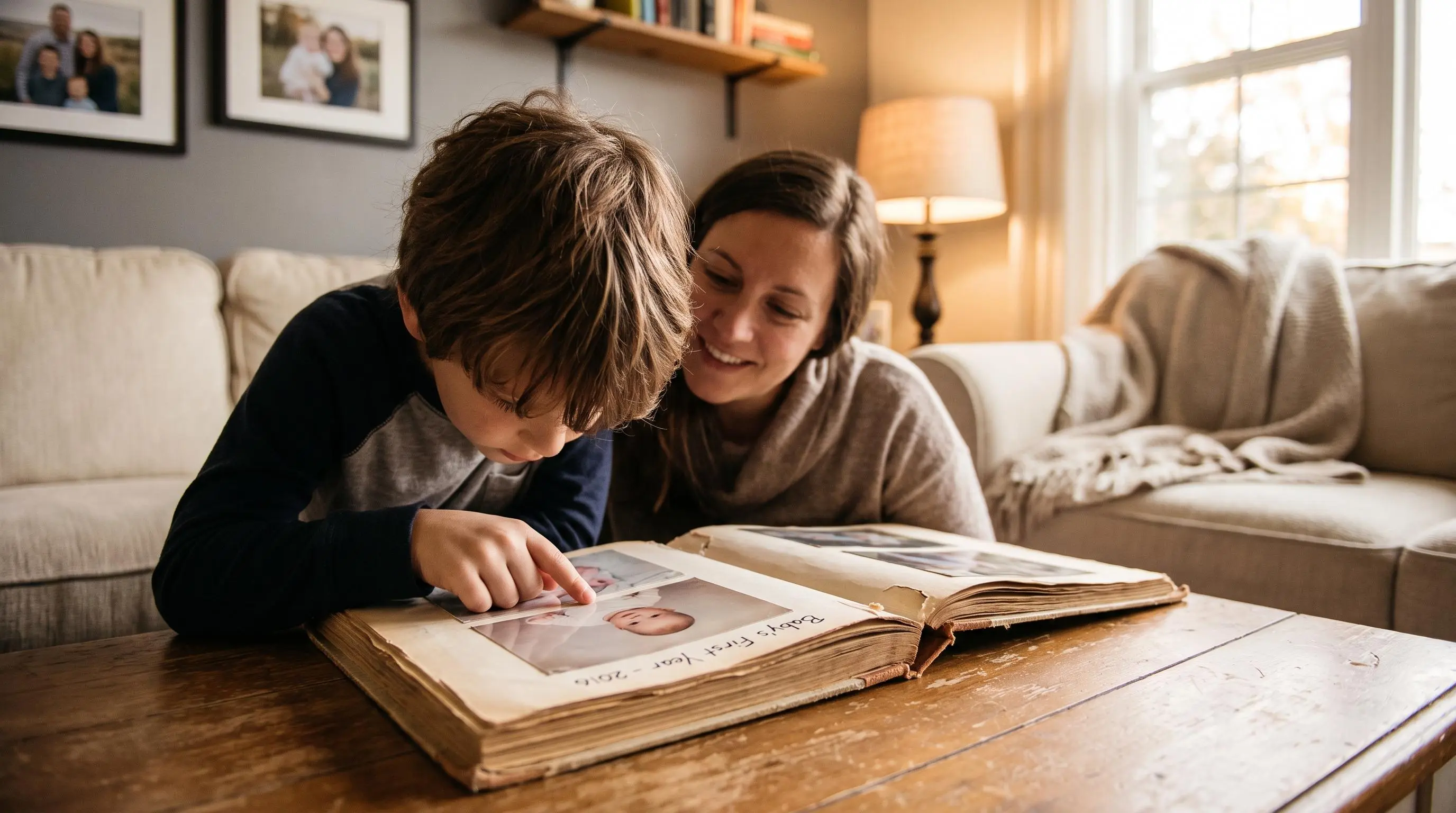
Family memories in print do more than decorate a room. They shape the emotional feel of a home in small, steady ways.
A hallway portrait says, this family exists here. An album on a coffee table says, these moments are worth revisiting. A framed newborn image in the nursery says, you were cherished from the start. A maternity portrait displayed before the baby arrives gives that season a place, not just a due date.
Repeated visual contact matters. A child who grows up seeing family photographs around them isn’t just looking at pictures. They’re absorbing belonging. They are learning, over time, what their story looks like.
Parents feel this too, sometimes unexpectedly. The seasons that felt chaotic while you were in them often gain meaning when you see them from a little distance. A printed photograph can return dignity to a season that felt mostly like survival.
Why shared viewing changes memory
Screens tend to isolate. One person scrolls. Another person misses it. Printed photographs are communal by default.
They prompt questions:
- Was that our old house?
- Look how tiny she was.
- Who’s holding him there?
- Remember how your brother wouldn’t let go of the baby that week?
That kind of storytelling builds family memory in real time. And because prints don’t depend on updates, apps, or logins, they keep doing that work quietly for years.
Print makes memory active. Not just archived.
Fleeting Seasons Deserve More Than a Camera Roll
If you’re expecting, holding a newborn, or trying to keep up with a growing family, you already know how fast a season can move. Some stages deserve more than being buried between screenshots and school reminders.
Pregnancy is brief and physically transformative. Newborn days are tender, blurry, and gone almost as soon as you start learning the rhythm. Family life changes shape every year, often before you’ve named what changed.
These are the seasons people photograph heavily and print rarely. That’s backwards.
The more fleeting a season is, the more valuable it becomes to make it visible in the home. Not because every moment felt perfect. (Usually it didn’t.) Because it mattered anyway.
At McKinley Hodge Photography, that’s part of why maternity, newborn, and family sessions are built with artwork in mind from the start. Our Maternity Photography sessions are designed to document a short, identity-shaping season, and designed with heirloom artwork intended for display in mind. Our Newborn Photography sessions happen in your home, which matters when leaving the house with a brand new baby feels like too much, and those early details change quickly. Our Family Photography experience also extends beyond the session itself into albums and wall art, so the images don’t stop at digital delivery.
A few images I feel are almost always worth printing:
- the way siblings looked at the new baby
- the mother’s changing body during pregnancy
- the full family together (including the parent who’s usually behind the phone)
- the ordinary gestures that tell the truth of the season
Those frames age well. Better than people expect. Don’t forget, they can tell the story together!
Heirloom Artwork Benefits Go Beyond Decor
When people hear the phrase heirloom artwork benefits, they sometimes assume it just means expensive printing. That’s not really it. Heirloom artwork is about making meaningful photographs in a form built to last, be handled, and stay visible.
There is a difference between quick commodity printing and heirloom-minded printing. Both have a purpose. A fast print from your phone can be great for a fridge or a school project. But albums and wall art meant to carry family memory over time need more thought behind them. They deserve unparalleled quality.
That shows up in a few ways:
- better materials
- better finish and color stability
- more intentional design
- a better chance of surviving moves, storage, and everyday life
And families feel that difference. Artwork that looks finished tends to stay out. It gets valued. It doesn’t end up shoved in a drawer after a move because no one was quite sure what to do with it.
For family sessions especially, that can mean albums, acrylic prints, fine art canvases, and framed prints. Different formats serve different uses, but the underlying benefit is the same: the image has been treated with the seriousness the memory already deserves.
Heirloom quality isn’t about luxury for its own sake. It’s about not handling important memories casually.
For a photography business like ours, the session is only part of the work. The end result should live well in your home.
The Real Power of Printing Is Curation
Modern printing isn’t about printing everything. Honestly, that would miss the point. The real power is selection.
Curation solves a problem digital life creates. It helps you identify which images actually represent a season instead of drowning in duplicates, screenshots, and good-but-not-meaningful frames. Families usually don’t need more pictures. They need clearer decisions.
The act of choosing has value too. When you review images with intention, you reconnect with moments you’d already started to forget. You notice what mattered. Sometimes it isn’t the technically perfect frame. It’s the one with the hand on the shoulder, the laugh breaking through, the child leaning in without being asked.
A useful filter is simple:
- print images that hold emotion
- print images that show identity and relationship
- print milestones and everyday connection
- print the photos that will still matter when current trends feel dated
Many families are printing fewer total images now, but placing more value on premium photo books and meaningful wall art. That shift makes sense. You do not need to print everything. Only the images you want to live with.
How to Build a Simple Print Habit That Actually Lasts
Most families don’t avoid printing because they don’t care. They avoid it because the task feels too big. So the habit needs to be small enough to survive real life.
Start with a simple system:
- Create one digital folder labeled for future printing.
- Add favorites to it as the year unfolds.
- Set a monthly, quarterly, or seasonal date to review and print.
That’s enough to start. Don’t build a complicated workflow you’ll abandon by February.
If you’re overwhelmed, narrow the scope. Choose one season, one room, or one album. Start with pregnancy, newborn days, a family milestone, or even just the last year of everyday life. Momentum matters more than ambition here.
A few practical habits help:
- label albums with names, dates, locations, and occasions
- write context on the back of loose prints using appropriate materials
- keep printed albums accessible instead of boxed away
- rotate framed images at home as seasons change
- maintain digital backups alongside printed favorites
And of course, if you choose to work with a professional photographer like me, you won’t walk away without a selection already heading to print! Talk about streamlining the process. 😉
When guidance helps
Some families want the memories, but not another DIY project hanging over them for six months. That’s where a guided, full-service portrait experience can take real weight off. When the artwork is considered from the beginning, you’re less likely to end up with beautiful files and no finished result.
That’s not about doing more. It’s about leaving fewer meaningful things unfinished.
How to Decide What to Print First

If you’re ready to act, don’t start with the whole archive. Start with the irreplaceable.
A practical order usually looks like this:
- pregnancy and newborn images
- full-family portraits with every member included
- transitions and milestones
- images attached to memories that already matter deeply
Then match the format to how the image should be experienced.
Albums work well for storytelling. A newborn story often belongs there because it includes so many small changes, details, and connected moments. Wall art works best when one image carries strong emotional presence and deserves daily visibility (but don’t forget, wall art can be appreciated as a collection too). Matted or framed prints are useful for gifting or rotating through your home over time. A maternity portrait can become an anchor piece before the baby even arrives.
Choose based on life, not just screen appeal. Some images look great on a phone and don’t need more than that. Others feel different once printed. Stronger. Truer.
Don’t wait for the perfect master plan. Start with the images that would hurt to lose and deserve to be seen.
Printing Photos Is an Act of Memory, Love, and Legacy
The importance of printing photos endures because printed images do something digital files alone cannot. They create access. They create connection. They create continuity across time inside an ordinary home.
Digital files are useful. They’re just not sufficient by themselves.
Printed photographs make memory visible. Heirloom artwork benefits families because it gives meaningful images a durable, shareable form. It turns a private archive into something your family can return to without effort.
If you want a grounded next step, keep it simple:
- choose one season that matters
- select a small set of images
- turn them into something your family can see and hold
For families in Cumming, Alpharetta, Milton, and the surrounding areas who want portraits created with printing in mind from the start, joining me for a guided maternity, newborn, or family session can make the process feel less overwhelming and far more lasting. Because the goal isn’t just to have photos.
It’s to live with them.

Be the first to comment